Welcome to the MOSL Book Challenge


Showing posts with label Nazi Germany. Show all posts

Wednesday, April 1, 2020

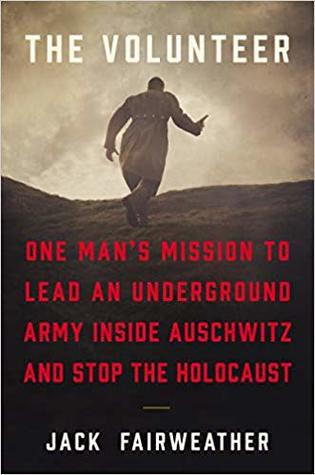
The Volunteer: The True Story of the Resistance Hero Who Infiltrated Auschwitz by Jack Fairweather

The Volunteer: The True Story of the Resistance Hero Who Infiltrated Auschwitz by Jack Fairweather

In Nazi-occupied Poland, Witold Pilecki accepted a mission to infiltrate a mysterious new camp called Auschwitz along the Reich's border. His goal was to report Nazi crimes and raise an army to revolt. For the next two and a half years, Witold smuggled evidence of the Nazis' atrocities to the Allies, eventually shaping their response to the Holocaust. Yet after his show trial and execution in 1948, Witold's name was forgotten for decades--until the 1990s, after Poland's return to democracy.  

528 pages.

Sunday, July 31, 2016

The Zookeeper's Wife: A War Story by Diane Ackerman

Warsaw had one of the best-know zoos in Europe during the 1930's. In 1939, Germany invaded Poland, and  the ensuing bombing from the allies destroyed much of the city. Over the next few years, under German occupation, Warsaw Jews were confined to the Ghetto, the zoo animals were killed or taken by the Nazis for their own German zoos, and the zookeeper became a major player in the resistance.

During those years, the zookeeper, Jan Zabinaki,  and his wife used the grounds of the former zoo to hide weapons and ammunition, produce false papers for Jews, and even conceal Jews on the grounds, some in the animal cages. Using the diaries of Antonina Zabinski and other contemporary sources, Ackerman relates the story of over 300 Jews who were saved by this brave couple.

384 pages

Saturday, January 31, 2015

Stones from the River by Ursula Hegi

Trudi Montag is a  Zwerg (dwarf) short, undesirable, different,  living in a small town in Germany in this story that spans both World Wars. Her father fought in World War I, and her mother is a mentally disturbed woman who rejects her daughter when she is born.

When Trudi is two, her mother embraces her one day, and falls in love with her. The two become inseparable, until her mother kills herself while once again in the insane asylum. Her father, who has always been Trudi's primary caregiver,  is a librarian of his own pay library, running the library out of their home and charging patrons to borrow books. Trudi eventually takes over, becoming the town librarian, where she is able to learn secrets while spying on the townfolk.

Trudi is deeply resentful of her physical difference, but learns to use her uniqueness in a variety of ways to her advantage, mostly to discover the secrets of various villagers, but also to enact vengeance toward others.

 She discovers various gifts she has, from her own bravery in the face of mass evil to being able to see into people's hearts. During World War II, she shelters Jews in her basement. Through her eyes, readers see the growing impact of Nazism on the ordinary townsfolk of Burgdorf as they are thrust on to a larger moral stage and forced to make choices that will forever mark their lives.


531 pages
Tuesday, September 16, 2014

The Boys in the Boat:Nine Americans and Their Epic Quest for Gold at the 1936 Berlin Olympics by Daniel James Brown

Most of us are familiar with the story of Jesse Owens at the 1936 Olympics, held in Nazi Germany. Not so with the U. S. Rowing team, who took gold in the 8-oar crew race. The boys in the boat were from the University of Washington, not one of the elite East Coast crews. They were farmers and loggers, boys who were mostly poor and poorer. They are still sometimes referred to as the greatest crew in U. S. history.

This history reads like a novel. It tells the story of Joe Rantz, who sat in the 3rd seat in the rowing shell. His mother died when he was three, and he was abandoned by his father at two different times in his life; once when he was but 10 years old, and again for good when he was 15, left to make his own way in the world with no family, no home, no money.

There were no scholarships in rowing when he entered the University of Washington in 1933, but securing a place on crew would give him the opportunity for a job that would help him keep himself in school.

The other part of the book is the many catastrophic events rocking the country during the 1930's, and the rise of the Nazi party and Adolph Hitler in Germany. The Great Depression was in full throttle; the Dust Bowl was devastating agriculture, and cataclysmic weather events were coming fast and furiously. Against this backdrop, the story of nine young men overcoming seemingly insurmountable odds to defeat the German and Italian teams that had all the resources they needed to become the best rowers in the world is inspiring and awe-inspiring.

417 pages

Friday, January 31, 2014

The Book Thief by Marcus Zusak


9-year-old Liesel Meminger doesn’t know how to read when her mother leaves her with a foster family in Molching, Germany in 1939. On the train that takes them to Molching, her little brother dies, and after he is buried, she finds a book dropped by one of the grave diggers. This is her first book theft. Her foster father teaches her to read using this book, which happens to be ‘The Gravedigger’s Handbook’.

Liesel’s story continues through the war years, through bombings, a Jew hidden in the basement, and her foster father being conscripted into the German army. Through it all, she continues to find books to steal and read, even reading them aloud in the bomb shelter during air raids to distract her neighbors.

This is a very good book about the everyday lives of ordinary German citizens during the Nazi regime.  Most World War II stories are about the Germans as aggressors; it is seldom that the average small-town person is depicted in literature.

578 pages