Welcome to the MOSL Book Challenge


Showing posts with label Poverty. Show all posts

Wednesday, November 2, 2022

Demon Copperhead by Barbara Kingsolver

Not me mixing up David Copperfield and Great Expectations for like...the first few chapters, cause that's how far I've read in Great Expectations.
Bro.....twas heavy... I mean of course it is cause it's talking about poverty and the foster system and drug abuse and homelessness and living in rural areas where there's really only one trade...
Also I'm sure this is how Dickens ends it, but like....hi I would appreciate a little more content at the end....for reasons...
560 Pages

Sunday, September 22, 2019

Nomadland: Surviving America in the Twenty-First Century by Jessica Bruder

Nomadland: Surviving America in the Twenty-First CenturyNomadland: Surviving America in the Twenty-First Century by Jessica Bruder
My rating: 4 of 5 stars

Far more depressing than I expected it to be. I guess I hoped for a bit more adventure and the formation of unique family and friends groups, and what I got was harsh reality. That was probably good for me, but I can’t say I exactly enjoyed this read. It’s more like I survived it and worried myself to death in the process.

Pages: 320

Friday, August 30, 2019

Heartland: A memoir of Working Hard and Being Broke in the Richest Country on Earth by Sarah Smarsh

Sarah Smarsh is from a fifth generation Kansas wheat farm family on her Dad's side, and the product of generations of teen mothers on her Mother's side. Writing about her experiences growing up on a farm west of Wichita, she gives her perspective into the lives of poor and working class Americans living in the heartland.

Her legacy was a work ethic that enabled her to create a solid professional life for herself, but that doesn't alleviate the pain of growing up seeing the way that poor people are marginalized and made to feel
"less than".

304 pages

Tuesday, January 8, 2019

Ramona Blue by Julie Murphy

Ramona BlueRamona Blue by Julie Murphy
My rating: 4 of 5 stars

This charming YA novel is about Ramona, who has blue hair, dates girls, lives in a small town, is poor, and has accepted small options for her life. That’s the surface level stuff.

Really, it’s about how sexuality is more fluid than fixed, and instead of putting people into neatly labeled boxes, we should be opened minded and accept who they are and who they love, at any given moment. We don’t need a perfectly thought out and permanently fixed label in order to love and accept people in our lives. It seems like labels are more about making others comfortable than they are about allowing people to be who they really are, which often includes changing and growing.

Anyway, long story short, Ramona considers herself a lesbian, until she starts to fall for a guy. Then she’s pretty confused, and it doesn’t help that the people in her life react in extremes on both sides of the is-Ramona-or-is-she-not-a lesbian line. There are those who reject her relationship with a boy on the grounds that she is definitely a lesbian, and there are those who are stoked about her relationship with a boy, as they felt that being a lesbian was “just a stage” that Ramona was destined to grow out of.

Sadly, very few people just have Ramona’s back and tell her to trust herself and her own feelings, and it’s not because her life is full of terrible people. It’s because her life is full of people who don’t see outside of their own life experiences.

This was supposed to be a short review, and it suddenly grew long. So I will wrap this up now by saying that it’s a good read that deals with a lot of issues, both related to sexuality and not. Overall, I enjoyed the story, the diversity, and the lovable characters.

Book 11 read in 2019

Pages: 408

Monday, March 26, 2018

Hillbilly Elegy: A Memoir of a Family and Culture in Crisis by J.D. Vance

Hillbilly Elegy: A Memoir of a Family and Culture in CrisisHillbilly Elegy: A Memoir of a Family and Culture in Crisis by J.D. Vance
My rating: 4 of 5 stars

This is a good look at poverty and violence, and the struggle it is to grow up inside them and to then try to make a life outside of them. It's a lot about class, community culture, and the persistent trauma of growing up inside a culture of constant stress and drama. Honestly, this hits very close to home, even in Missouri, and I know many people who grew up in such a way or are still trapped and impacted by similar childhoods.

My brother said this was a boring book, because it's everything he already knows about the impacts of growing up in poverty and despair. In fact, his exact words were, "I thought it was boring and not that good, but we grew up in a poor area, so it wasn't anything groundbreaking."

This had me thinking about why my brother would expect a book about a culture in crisis to be groundbreaking. Does he feel as if there is some kind of reason or solution to poverty and violence that he does not yet know about? And why doesn't he want to see the reality of some of our life experiences reflected back in his literature?

My mother said, "It is suited to those who have always had advantages and money and don't understand those who haven't."

Now, on some level, I understand her comment, because she's suggesting that the value of the book may be in its shock value for all of those who haven't grown up in or surrounded by some level of poverty and hardship. But who in the world are these people? And what world do they live in that I don't? How many

Sunday, March 4, 2018

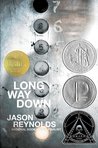
Long Way Down by Jason Reynolds

Long Way DownLong Way Down by Jason Reynolds
My rating: 5 of 5 stars

This book has gorgeous verse, a fast pace, and an interesting premise.

15-year-old Will decides to follow the code that has been passed down in his family for generations, and murder the boy whom he believes shot his older brother. Will tucks a gun into his waistband and gets on the elevator to take the journey towards this choice. But at every floor, someone gets on the elevator who sheds a new light on the choice that he plans to make.

The value of this story is in the journey, so I won't say more, other than that I enjoyed the journey, as much as you enjoy anything that is intense and emotional.

Book 88 read in 2018

Pages: 320

Tuesday, February 6, 2018

A River in Darkness: One Man's Escape from North Korea by Masaji Ishikawa

A River in Darkness:  One Man's Escape from North KoreaA River in Darkness: One Man's Escape from North Korea by Masaji Ishikawa
My rating: 4 of 5 stars

This is the true story of Masaji Ishikawa, born in Japan to a Japanese mom, and an abusive Korean father, who was lured by false promises of a utopian society to move his family from Japan to North Korea when Ishikawa was only 13 years old. The family became part of the lowest social caste, and all of them suffered immensely under the brutal totalitarian regime.

I've read some tough stories about people with very difficult lives, but the abject poverty experienced by Ishikawa completely unsettled me.

I'm shocked and horrified by the ways in which North Koreans were (and probably still are) forced to suffer. The constant indoctrination didn't surprise me, but the sheer stupidity and cruelty behind running an entire country and people into the ground was infuriating. It's so hard for me to wrap my mind around how an entire nation of people can be abused and kept down in such a way. They're so far down, they don't ever even consider rising up, probably because any attempt to fight back against the system only leads to more sorrow and loss.

If you had asked me to point fingers at which countries are the most guilty of crimes against their own people, North Korea probably wouldn't have made my top 5 list before reading this book. I mean, on some level, I knew things weren't great in North Korea, but I had no idea how bad it really was.

My only minor complaint is that I wanted more. More depth, more explanations, more emotions, more stories, and even more information on aspects of Ishikawa's daily life (and especially into his different relationships). I suspect some of what I really wanted to know was left out of this story or glossed over just due to sheer cultural differences. I'm sure it would have been deemed inappropriate for him to speak more in depth about either of his wives, and specifics of his relationships with them, but I definitely wanted to know more about all of that.

This is not a story of hope, so what's beautiful about it is the honest way in which the story is told.

Book 51 read in 2018

Pages: 172

Saturday, December 31, 2016

Hillbilly Elegy: A Memoir of a Family and Culture in Crisis by J. D. Vance

J.D. Vance grew up in the Rust Belt city of Middletown, Ohio, and the Appalachian town of Jackson, Kentucky. He enlisted in the Marine Corps after high school and served in Iraq. A graduate of the Ohio State University and Yale Law School. In this memoir, he gives an insider's analysis of a culture in crisis. He talks about the struggles of white, working-class American's, as seen through the prism of his own family.

His grandparents moved north from Appalachia to escape the poverty that permeated their existence, and provide a better opportunity for their children to move up into the middle class. That worked for them with employment in the steel mills of Ohio. Yet the family struggled with the demands of the middle-class, and Vance chronicles how social and class decline feels like when you grow up in it.

A lot is being written these days on the decline of this segment of the population, and the abuse, poverty, and drug and alcohol abuse so prevalent among this culture. No one has written it in such stark terms, from the viewpoint of one who has lived it and escaped it, albeit with the scars to prove it.


272 pages

Sunday, September 18, 2016

Our Kids The American Dream in Crisis by Robert D. Putnam

This book was cited in this year's Kid's Count data issued by our Office of Social and Economic Data Analysis at MU.  Putnam explores how the 'American Dream' of opportunity has evolved from his generation, 1950s, to the experience of current young people age 18 through early twenties.  He focuses on the differences in parenting, families, schooling, and community.  The comparisons are stark, and highlight the stratification of neighborhoods into high income/low income with little interchange between them.  He describes consequences of that de facto segregation, using interviews with contemporary young people and their parents, contrasted with the experience of members of his generation. The basic insecurity, whether of shelter, family, inadequate schools, and drugs and crime in communities, of the lowest income families has meant that many children are growing up in very precarious situations.  And yet we expect these kids to conform to the ideals of the American dream, to understand how to navigate college or trade school and move into stable jobs.   Putnam offers some solutions, in the final chapter, but focuses most on local action, and not much on the more sweeping changes that would be needed to have any true impact. 368 pages

Sunday, May 8, 2016

Running for Water and Sky by Sandra Kring

Running for Water and SkyRunning for Water and Sky by Sandra Kring
My rating: 4 of 5 stars

I received an ARC in exchange for an honest review.

This is a solid read about real people, with real issues, and it never shys away from that or glosses over the difficult, ugly stuff.

There are some things I really love about this story, particularly the whole end of the novel, which just hit all the right notes for me. In fact, I felt like the story got stronger the longer I read. I confess, there were a few things along the way that bothered the obsessive YA reader that dwells inside me, which was why I sat on this review for a few days. I wanted to know if they even mattered, or if they were just things I fixated on while reading that don’t really impact what a unique and interesting story this was.

For the most part, they don’t matter, because what I’m left with after reading this story is reminders of the impact that poverty, abuse, and hardship have on emotional development and how challenging it can be for people to ever overcome that. I think that’s why this book was so rewarding for me, because it took people who should by all standards be broken and gave them moments where they could choose to grow. Sometimes they did. Sometimes they faltered or even backpedaled, but it was watching them have to confront their issues and demons that held my attention.

The story expertly captures those pivotal moments in people’s lives where they can either rise up and overcome or give up and slip back into dysfunction. Watching all those internal struggles was both fascinating and upsetting for me. Sometimes I had to close the book and set it away from me for a moment, but I found that I would almost immediately pick it back up and start reading again. It’s like I needed space from the weight of the story, but I also didn’t want it.

I could sit here and point at a few things I thought could be improved, in terms of the writing and unique format of the story, but why would I? The reality is that I read this through within 24 hours, and it had an emotional impact on me, which means the story is effective. I cared about what happened to these characters, and I am glad I went on the journey with them.

Pages: 282


Thursday, March 31, 2016

The Illegal by Lawrence Hill

Image result for the illegal by lawrence hill
Lawrence Hill is a fine writer, however, this is not one of his better works.  It is the story of an exceptional runner, Keita Ali, who is from a fictitious country that seems to almost breed exceptional runners.  His father is an investigative journalist (oh, and he is a also a character from another of Hill's works, but there is no reason for this recycled character, for there is no thread between the books).  The father is brutally murdered by the evil rulers of the fictitious country because of some secret investigation he was involved in.  Keita is forced to flee the nation before the cardboard cutout evil rulers get their hands on him.  There is no explanation as to why they are so interested in the Ali family.  Keita flees to a neighboring nation, where he is befriended by an odd assortment of characters who provide him with shelter, decent food and health care, and help him to enter one race after another in order to earn his way to clearing his father's tarnished name.  I kept hoping something would evolve, which would answer some of my questions, and most especially the largest one, which was why I kept reading.  But I did, if for no other reason than to warn unsuspecting readers who might be familiar with the author not to bother with this book.
400 pages

Tuesday, November 25, 2014

"A Bulletin on the Condition of the County Almshouses of Missouri" by Charles A. Ellwood

Published in 1904, this sad document discusses the county almshouse, which housed the poor and indigent along with "defective classes."  Included are the 1903 statistics on ninety of these institutions.  The author, a sociology professor from the University of Missouri, advocates separation of "inmates" by sex, race, health, and mental/moral condition.  He calls for legislation to improve the almshouses and prevent abuses, and he ends by recommending that Missouri follow England's example of  administrative control over their "workhouses."  This book is in our Missouriana collection and is the second that I've read on the subject this month; that's enough for me.  31 pages, copyright 1904.

Tuesday, November 4, 2014

"County Almshouses and Jails of Missouri" by William T. Cross and Charlotte B. Forrester

Published in 1912, this sad little book is the text of a speech given by Cross, the secretary of the Missouri State Board of Charities and Corrections, at the state Nurses' Association's annual meeting on Oct. 16, 1912.  It describes what Forrester saw throughout the state when she visited county jails and almshouses (which housed the poor) and includes a few badly reproduced photographs of their inhabitants.  Some of the places were praised but most were poorly run and the people housed there terribly mistreated, especially the mentally ill.  Women and children were not always separated from the men, and rapes were not unusual.  Cross's racism is also in evidence by his insistence that non-whites be kept away from whites.  What a sad and depressing time in history.  23 pages, copyright 1912.

Tuesday, September 30, 2014

Men We Reaped: A Memoir by Jesmyn Ward

Jesmyn Ward grew up in rural Mississippi during the 70's, 80's and 90's.  Her father was incapable of being faithful, although he loved his wife and wanted to support and care for his children. Her mother eventually kicked him out, and raised her, her brother, and two younger sisters alone, working as a housekeeper for wealthy white families. It was a life of unrelenting poverty, racism and hopelessness.

One of her mother's employers asked to send Jesmyn to a private school when he found out she was being bullied in her public school. Her mother agreed, wanting at least one of her children to have a chance to work her way out of their dismal circumstances. Jesmyn went on to get a master's degree in fine arts, and became a writer, winning a National Book Award for Fiction, and an Alex Award.

After writing two novels, she began writing this memoir, trying to  make sense of the deaths of five young men in her life over a five year span of time. Suicide, accidents, a shooting; all five, including her  brother, died in different ways, but the fact of their deaths seemed to be a symptom of the desolate lives they were living in this small southern state.

As I read, I kept thinking about the events in Ferguson, and that the life the author was describing explained much about the explosion of emotions that erupted after the killing of Michael Brown. Mississippi is dead last in the nation in so many measures of poverty, and Missouri is close on its heels. If we  want to  understand why  these things happen, this book can help.

Not an easy book to read, but highly recommended.

270 pages

Wednesday, April 9, 2014

Behind the Kitchen Door By Saru Jayaraman


(Posted for Paul Mathews)

She talked with the staff that had worked in the World Trade Center. Their trouble finding jobs and getting paid a living wage.  The problem of many skilled workers not getting upgrades to better jobs they could easily do. They worked from inside to improve the whole system.  175 pages.

Wednesday, July 31, 2013

Girlchild by Tupelo Hassman


Written as a stream-of-consciousness narrative from the viewpoint of a child, this book is an unrelentingly dreary view of the world of the very poor. Rory Dawn is the daughter of an alcoholic mother, and a gambling addict grandmother, both of whom made too many mistakes with too many men, and never found a way to lift themselves out of poverty.

They each made the same mistakes of their own mothers, and the reader is never given a glimmer of hope that Rory Dawn will be any different. She is gifted, but her teachers give up on her; her mother was dyslexic, but found a way to go to college, then blew it when she was arrested for marijuana possession.

And so the cycle continues. We’re all familiar with the stories of those who somehow made it out, but those who don’t are often hidden from us. If you want them to stay hidden, don’t read this book.


289 pages