Welcome to the MOSL Book Challenge


Showing posts with label feminism. Show all posts

Monday, May 16, 2022

The Dictionary of Lost Words

 The Dictionary of Lost Words

By Pip Williams

Pages: 400

"Esme is born into a world of words. Motherless and irrepressibly curious, she spends her childhood in the "Scriptorium," a garden shed in Oxford where her father and a team of dedicated lexicographers are collecting words for the very first Oxford English Dictionary. One day a slip of paper containing the word "bondmaid" flutters to the floor. She rescues the slip, and when she learns that the word means slave-girl, she withholds it from the OED and begins to collect other words that have been discarded or neglected by the dictionary men. As she grows up, Esme realizes that words and meanings relating to women's and common folks' experiences often go unrecorded. And so she begins in earnest to search out words for her own dictionary: The Dictionary of Lost Words. "

This was an interesting dive into how the dictionary was created and how historical events such as the woman's suffragist movement and WWII affected the creation and selection of words. Esme collects ones that are rejected from the formal dictionary, mostly written or said by women and minorities and turns them into her own dictionary and gives them a voice. I really enjoyed this book and I often do not read historical fiction, but the bookworm in me was intrigued by the title and I am glad I picked it up.

Thursday, March 17, 2022

Algorithms of Oppression

 Algorithms of Oppression: How Search Engines Reinforce Racism

By Safiya Umoja Noble

Pages: 256

"In Algorithms of Oppression, Safiya Umoja Noble challenges the idea that search engines like Google offer an equal playing field for all forms of ideas, identities, and activities. Data discrimination is a real social problem; Noble argues that the combination of private interests in promoting certain sites, along with the monopoly status of a relatively small number of Internet search engines, leads to a biased set of search algorithms that privilege whiteness and discriminate against people of color, specifically women of color."

I started reading this as a part of a class assignment and got pulled in to finish the rest of it. The conversation that Safiya has started with this book really makes me rethink how I use the internet and the repercussions it has on minorities. My one critique is that she often repeats the same examples and re-explains her concept that she outlined in the first chapter throughout the whole book.

Thursday, February 6, 2020

Dear Ijeawele, Or, A Feminist Manifesto in Fifteen Suggestions by Chimamanda Adichie

Dear Ijeawele, Or, A Feminist Manifesto in Fifteen Suggestions

Yassss. This is how I would want to raise a kid. A lot of it I've heard before, but some suggestions gave me things to think about.

A quick feminist read by a great thinker.

63 pages

Wednesday, January 29, 2020

Lives of Girls and Women by Alice Munro

Lives of Girls and Women

A series of short stories depicting Del, a young girl growing up in a small rural Canadian town in the 1940's. Definitely an important early example of a feminist novel, hitting themes of sexuality, sexism, and the economic prospects for women in that era. I also enjoyed reading a book set in the 40's that wasn't about World War II, but rather focused on everyday life. It's a good read, if a bit slow, and a bit outdated at this point-it was published in 1971.

Beautiful writing, worth a read for those who enjoy slice-of-life stories.

277 pages


Friday, February 15, 2019

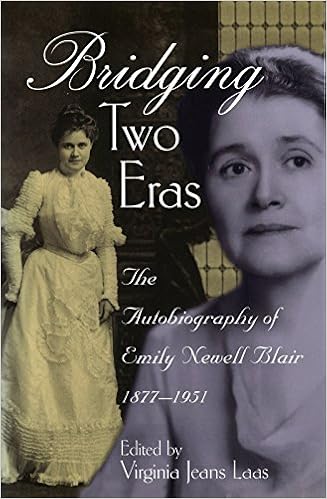
Bridging Two Eras: The Autobiography of Emily Newell Blair, 1877-1951, Edited by Virginia Laas

Bridging Two Eras: The Autobiography of Emily Newell Blair, 1877-1951, Edited by Virginia Laas

Emily Newell Blair, having lived through the end of the nineteenth century to the middle of the twentieth, viewed herself as a bridge builder. A dedicated feminist who successfully managed to be both a Midwestern housewife and an outspoken suffragist on the national scale, Emily wanted to give others a glimpse into life during the upheaval of transition. Emily's autobiography, written in 1939 and published in 1999, provides insight into her life in southwest Missouri, her career as a writer, and her progression through American politics.

382 pages. 

Tuesday, August 14, 2018

We Should All Be Feminists by Chimamanda Ngozi Adichie

We Should All Be FeministsWe Should All Be Feminists by Chimamanda Ngozi Adichie
My rating: 5 of 5 stars

Adichie thoughtfully and profoundly writes about what it means to be a feminist today. We should all be feminist because the feminist tenet of social and economic equality of the sexes frees us to be the people that we are rather than who gender tells us that we should be, enabling humankind to have a happier, healthier existence.

52 pages

Saturday, March 24, 2018

We Should All Be Feminists by Chimamanda Ngozi Adichie

We Should All Be FeministsWe Should All Be Feminists by Chimamanda Ngozi Adichie
My rating: 5 of 5 stars

This is the best discussion of gender that I have read in quite some time, and it gets to the heart of what feminism really should be (outside of all the negative stereotypes that are part of the gender divide). It also has quite a bit to say about the harm that culture can do to men, as well.

Some of my favorite quotes: (to avoid spoilers, don't read onward)

Sunday, February 22, 2015

The Invention of Wings by Sue Monk Kidd

Sarah Grimke grew up in Charleston, South Carolina during the nineteenth century. Her family was part of the privileged, wealthy,  slave-owning class; her father was a renowned judge, and they were considered at the top of the planter class, the elite of society. Yet at a young age, Sarah somehow became opposed to slavery. As a young woman, she became a Quaker, moved north, and became an abolitionist. Later, she and her younger sister, Angelina, became the first female abolition agents in America, and among the earliest feminist thinkers.

This is a fictionalized story about Sarah and a slave girl given to her on her eleventh birthday to be her personal maid. Hetty was the same age as Sarah, and their stories are told in alternating chapters of the book. The story of Sarah is based very closely on the actual historical events. However, the story of Handful (Hetty's slave name) is largely fiction.  The two parallel stories draw a stark contrast between the lives of slaves, and those who enslaved them.

This is a powerful book about the ways in which societies structure themselves on power and privilege - and then lie to themselves about the injustice inherent in these systems.


384 pages

Sunday, June 29, 2014

The Ten Year Nap by Meg Wolitzer, narrated by Alyssa Bresnahan

I picked this book to read because of its title.  I would love a ten year nap! But in this case the nap refers to the time spent as a stay at home parent.  The book follows four New York friends who have chosen to stay at home with their children and who are now contemplating a return to paid employment.  Understandably, they have mixed feelings about going back to work.  Have they fallen too far behind?  What if they don't want to go back?  Just to make it interesting, Wolitzer interleaves each friend's story with her mother's during the Women's Liberation movement and lets the husbands tell their stories too.  383 pages. 13 hours 39 minutes.

Tuesday, August 9, 2011

Bram Stoker's Dracula

Yes, I'm not straying far from the vampire fiction, it seems.  Here he is, Bram Stoker, the grandaddy of the genre.  I really didn't think I would have anything new to say, but a classic is always new when you read it with an open mind.  Some things surprised me, some things didn't.  For instance, I've seen the 1992 Coppola-directed adaptation of this novel, and I was very surprised at how closely the film followed the book-with one exception--the romantic interludes between our favorite blood-sucker and Wilhelmina Murray (Gary Oldman and Winona Ryder) were completely manufactured by the screenwriters.

One thing that didn't surprise me was the experience of reading the book was very much colored by all the many Dracula images western culture has dished up over the decades.  I had alternating visions of Christopher Lee and Gary Oldman dancing around in my head while I read this and, unfortunately, I could not get Keanu Reeves as Jonathan Harker out of my head either.

The most surprising thing, however, came as I read the chapters that detailed the whole vampire hunting gang as they put their many pieces of the puzzle together, with Mina typing up everyone's diaries and creating a narrative.  This is an epistolary, and as such it is made up of letters and journal entries (Dr. Seward uses the "phonograph" for journaling, Mina uses shorthand), so you get a new pov on every other page.  Mina, with her "brain like a man," is at one point cut out of the vampire hunting strategy sessions due to her female delicacy.

This turns out to be a very bad idea, for the Count likes the ladies, and finds his way into her boudoir while all the stodgies are puffing tobacco, swilling brandy, and theorizing in the man-chamber.  After her blood is nearly drained one evening, the men finally learn their lesson and bring Mina back into the fold.  This is good, because Mina's strong intellect is the only thing keeping this ragtag operation one step ahead of the Count.

Could it be that Bram was an early feminist?  I can't help thinking that he had no compunction about showing what boobs the men-folk were for their exclusion of Mina.  Though Van Helsing frequently shines as the man of the moment, he'd be nothing if he didn't recognize what he had in Mina and the two form a partnership of sorts.  Stoker really drove it home over and over again with Mina using maps and her many notes to divine what the Count would do next, using her psychic connection with the Count to track him over land and sea, and fighting the metamorphosis from human to vampire as the Count's blood took hold...it's very clear that Mina is far more worthy, intelligent, and at least as brave as her male companions.  You go, Bram!

448 pages