Welcome to the MOSL Book Challenge


Showing posts with label education. Show all posts

Friday, April 26, 2019

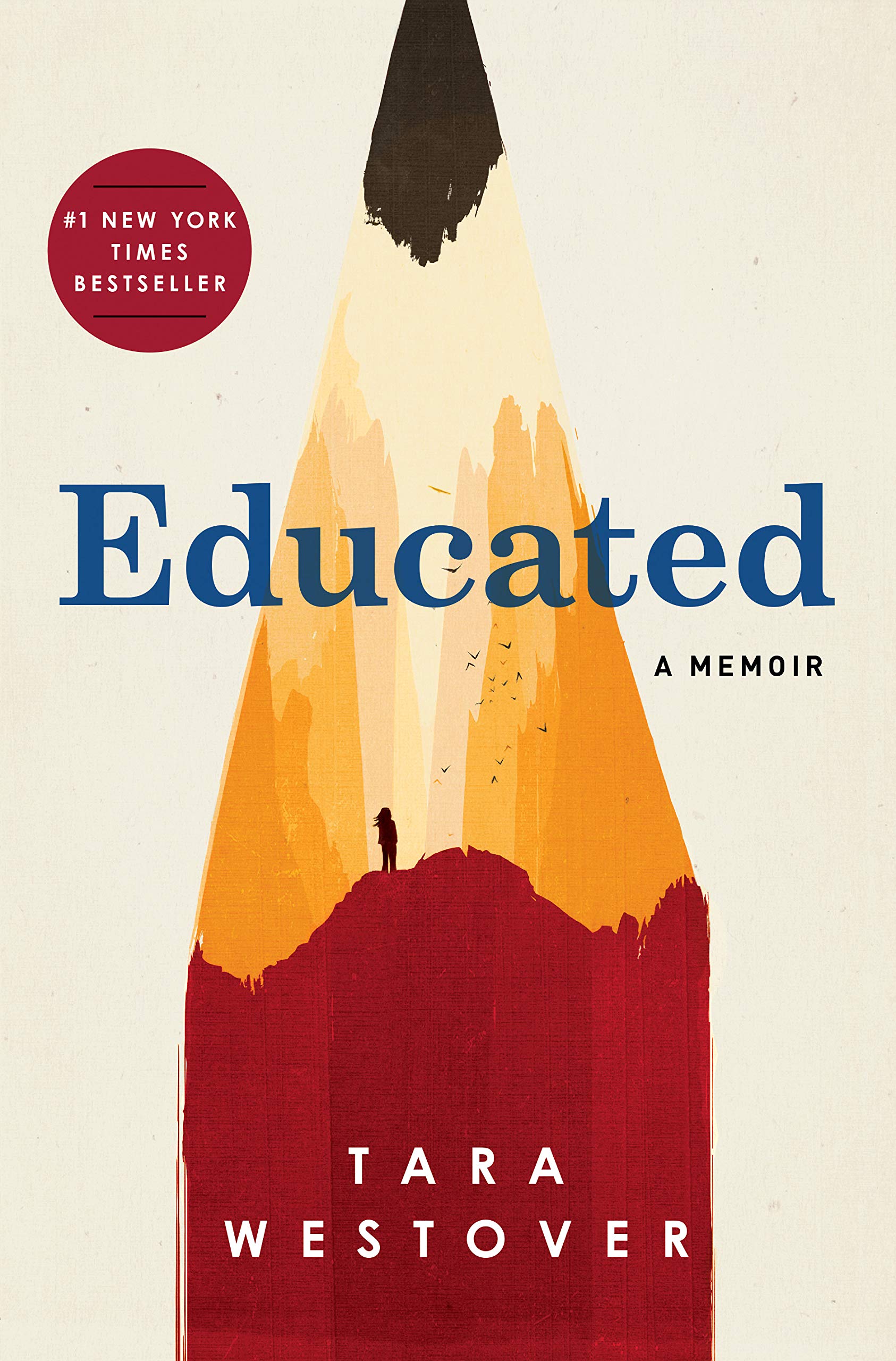
Educated: A Memoir by Tara Westover

Educated: A Memoir by Tara Westover

Born to a survivalist family in the Idaho mountains, Tara had never set foot in a normal classroom or been to a doctor. The family spent their time preparing for the End of Days by working in their father's junkyard or stewing herbs with their mother, a midwife and healer. When an older brother decides to go to college, Tara can't help but become curious about the outside world. She taught herself enough to get the score necessary to gain a scholarship to BYU. Once in college, she begins to question her family's way of life, eventually questioning the meaning of family itself.

While I normally avoid mentioning my personal feelings toward a book in a post so that people can reach their own conclusions about whether or not they want to read the book, I cannot recommend this book enough. Tara's struggle to understand her family and her quest for self-invention is astonishing and beyond admirable. I've had many fiction books take me on an emotional journey, but I've never found a nonfiction book that resonates quite like this one.

352 pages.

Monday, September 24, 2018

I'd Like to Apologize to Every Teacher I Ever Had: My Year as a Rookie Teacher at Northeast High

 I'd Like to Apologize to Every Teacher I Ever Had: My Year as a Rookie Teacher at Northeast High
by Tony Danza
Pages:
Rating: 4 out of 5 stars

What starts out as an idea for a documentary television series becomes a lesson in the real-life struggles of teachers and teens across America, especially in the inner cities. Actor, Tony Danza started college wanting to teach high school history before he discovered acting. Now he has the chance to teach for one-year in inner city Philadelphia. But only one class a day of Sophomore English with a teacher agreeing to sit-in and monitor everything he does. The school board wants to make sure their students still get an education while the tv cameras are rolling.

Tony learns that teaching is the hardest job is ever done, physically, mentally and emotionally. He becomes connected to his students and learns how times have changed since he went to school in the city. He also ends up working for half of the school year for free because he caught the film crew and producer talking the teens into making trouble just to "spice up" the footage. He and the principal demand they leave, but Tony is able to stay and finish out the year with the students.

Monday, December 4, 2017

I Am Malala by Malala Yousafzai

I Am Malala: The Story of the Girl Who Stood Up for Education and Was Shot by the TalibanI Am Malala: The Story of the Girl Who Stood Up for Education and Was Shot by the Taliban by Malala Yousafzai
My rating: 5 of 5 stars

I am either really emotional this morning, or this memoir just punches you in the feels over and over again. Reading about girls being unable to even go to school was really hard on my teacher's heart for so many reasons.

I hate that things like this happen in the world, but I like the messages that Malala has shared and continues to share because of it.

Pages: 327

Sunday, October 30, 2016

Reskilling America: Learning to Labor in the Twenty-First Century by Katerine Newman and Hella Winston

There's been a lot of promotion of the need for education beyond the high school degree, particularly promoting easier access to a four year college degree.  I don't believe that is the only, or even best path to success  for most Americans, and neither do these authors.  Newman and Winston take a close look at what kinds of job skills are needed in the current work force and how well our high schools, technical schools, community colleges and colleges are succeeding at helping young people learn those skills. They also examine some programs in other countries, particularly Germany, where there is a very close training and apprenticeship program available to most high school students that does a superior job of preparing students for today's high tech work environment.  It ain't your granddaddy's shop floor any more; now manufacturing jobs focus on fixing the robots that perform the actual work. That takes a good degree of applied math, and great problem solving and communication skills. Good food for thought, especially for those involved or interested in the education system.  246 pages.

Sunday, September 18, 2016

Our Kids The American Dream in Crisis by Robert D. Putnam

This book was cited in this year's Kid's Count data issued by our Office of Social and Economic Data Analysis at MU.  Putnam explores how the 'American Dream' of opportunity has evolved from his generation, 1950s, to the experience of current young people age 18 through early twenties.  He focuses on the differences in parenting, families, schooling, and community.  The comparisons are stark, and highlight the stratification of neighborhoods into high income/low income with little interchange between them.  He describes consequences of that de facto segregation, using interviews with contemporary young people and their parents, contrasted with the experience of members of his generation. The basic insecurity, whether of shelter, family, inadequate schools, and drugs and crime in communities, of the lowest income families has meant that many children are growing up in very precarious situations.  And yet we expect these kids to conform to the ideals of the American dream, to understand how to navigate college or trade school and move into stable jobs.   Putnam offers some solutions, in the final chapter, but focuses most on local action, and not much on the more sweeping changes that would be needed to have any true impact. 368 pages

Tuesday, November 24, 2015

Creating Innovators: The Making of Young People Who Will Change the World, by Tony Wagner

How do we foster innovation, curiosity, and problem solving skills in our children?  In order to grow the U.S. economy, different approaches are needed to develop a generation of innovators.  To investigate how to develop these skills, Wagner identified and interviewed a variety of young people who exhibit the skills of innovators. He uses their stories to identify common themes in their backgrounds; specifically a penchant for play, which develops into pursuing a passion, and is applied with purpose. He then compares what helped these young people to develop into innovators with the typical family and academic background.  In particular, he describes how our current educational system drives the creativity out of students in favor of teaching to the test.  His interviews with the parents of these young people is particularly interesting, as the parents all realized that their children did best when they were allowed to unleash their curiosity, but they often did not do very well in school.  There are many thought-provoking concepts here, particularly for parents, educators, and librarians.  251 pages.

Friday, May 29, 2015

Shakespeare Saved My Life: Ten Years in Solitary with the Bard by Laura Bates


Laura Bates was an English professor who began teaching Shakespeare to inmates in Indiana prisons. She eventually managed to get the prison system to allow her to teach a Shakespeare class in ‘SuperMax’; the ‘prison within a prison’ for the most violent, incorrigible criminals.


In this memoir, Bates describes the “Shakespeare in Shackles” where she met Larry Newton. Newton spent over 10 years in solitary confinement; as a teenager he murdered a man and got life in prison without parole in return for pleading guilty. Newton got Bates’ attention with his first essay about Richard III. He posed questions on topics such as honor, revenge and conscience.


The impact of Shakespeare's works, primarily Macbeth and Hamlet,  on Newton was so powerful that he became a teacher, prepared  workbooks to help inmates study, and helped create videos to inform other inmates about the relevance of Shakespeare to their lives. And the impact on  Bates has led her to ask questions such as: Should the state pay for educational programs to rehabilitate criminals? Need we be concerned about the inhumane and unsanitary conditions that exist in some American prisons? Can we prevent juvenile offenders from become career criminals?

 
An interesting read.


308 pages

Saturday, December 20, 2014

"Freakonomics: A Rogue Economist Explores the Hidden Side of Everything" by Steven D. Levitt, Stephen J. Dubner

I'd heard a lot about this book over the years but had never picked it up before now.  I've always found economics boring or incomprehensible, and some of the topics covered here were both (such as cheating in sumo wrestling!).  Lots of statistics were reported to back up the findings and could be a bit mind-numbing but there were some results that really surprised me, especially about teaching and child rearing.  The most interesting part dealt with the unusual names that African-Americans have given their children over the last couple of decades, why they do it, and the consequences for doing so.  Levitt is an economist, and Dubner is a journalist.  320 pages; about 6 hours on CD.

Friday, February 28, 2014

Three Cups of Tea: One Man's Mission to Promote Peace . . . One School at a Time by Greg Mortenson


In 1993, Greg Mortenson attempted to climb K2, the world’s second tallest mountain. He fell ill, and was cared for by villagers in Korphe, Pakistan, for seven weeks. They saved his life, and in return he promised to build them a school for their children.  That project grew into the Central Asia Institute, a charitable organization that continues to build schools in rural Pakistan and Afghanistan.  The book asserts that the way to fight Islamic extremism in the region is through collaborative efforts to alleviate poverty and improve access to education, especially for girls.


Since this book became a bestseller in 2006, Greg Mortenson has been accused of fabricating this account, and of using money raised for the Central Asia Institute for his own expenses. However, the book itself is still a powerful reminder that poverty and ignorance can best be combatted by education and friendship, not bombs and drones.

376 pages